
Moving on from the 1980 UK singles chart, today we roll back to 1981. In the second full year of the Thatcher government, we see that 1981 continues in much the same transformational vein as 1980. But what were the most popular songs of 1981?
Along with posthumous hits from the recently assassinated John Lennon, some fresh new sounds entered the charts; indeed, we saw the rise of genres that would define a generation. Echoes of punk still resonated and new wave began to impose its particular vibe and energy on a soundscape that was as diverse as it was dynamic.
My own record buying activity was strictly limited – I only own three singles from 1981. Two of which I bought after the event and the other, I liberated from my brother. And he hadn’t bought it himself; I think that he had exchanged it for something.
I’ll talk about these three singles, but more than that, I’m going to try and shed some light on the cultural and social context from which they and the rest of the chart emerged. It was a time marked by considerable unrest in several British cities.
It was truly a tumultuous period marked by widespread riots primarily involving Black English youth clashing with police. They occurred between April and July 1981 in cities such as Birmingham, Leeds, Liverpool, London, Manchester, and Nottingham.
Primarily due to racial tensions, economic hardship, and perceived police discrimination, particularly the use of stop-and-search tactics, the most notable incidents included the Brixton riots in London; the Toxteth riots in Liverpool; and disturbances in Handsworth, Birmingham; Chapeltown, Leeds; and Moss Side, Manchester.
The unrest led to significant injuries, property damage, and prompted the government to commission the Scarman Report, which highlighted the need for urgent action to address racial disadvantage and inner-city decline.
If any song from 1981 summed up the feeling in the inner cities, it was the Specials’ Ghost Town – the single that I liberated from my brother. Obviously, a fabulous track, Ghost Town made a poignant statement about Britain’s social climate. Yes, it evokes the inner-city riots but it spoke of deeper schisms in the country.
Unsettled Harmony: The Specials’ Ghost Town vs. Royal Wedding Euphoria
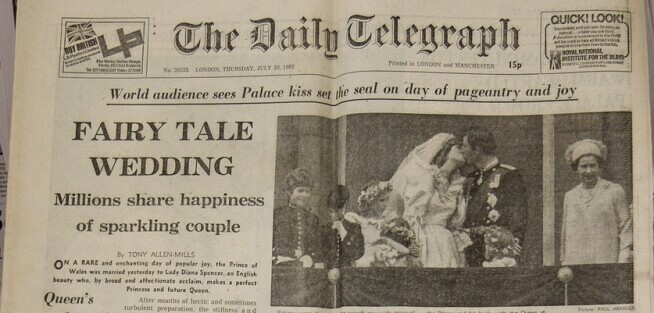
To the detached observer, it may appear curious that as Prince Charles and Lady Diana Spencer exchanged vows on 29 July 1981, a dissonant soundtrack lingered in the British airwaves. Having been the UK’s number one single for three weeks, Ghost Town, was knocked off the top spot by Shakin’ Stevens on the chart immediately before the wedding.
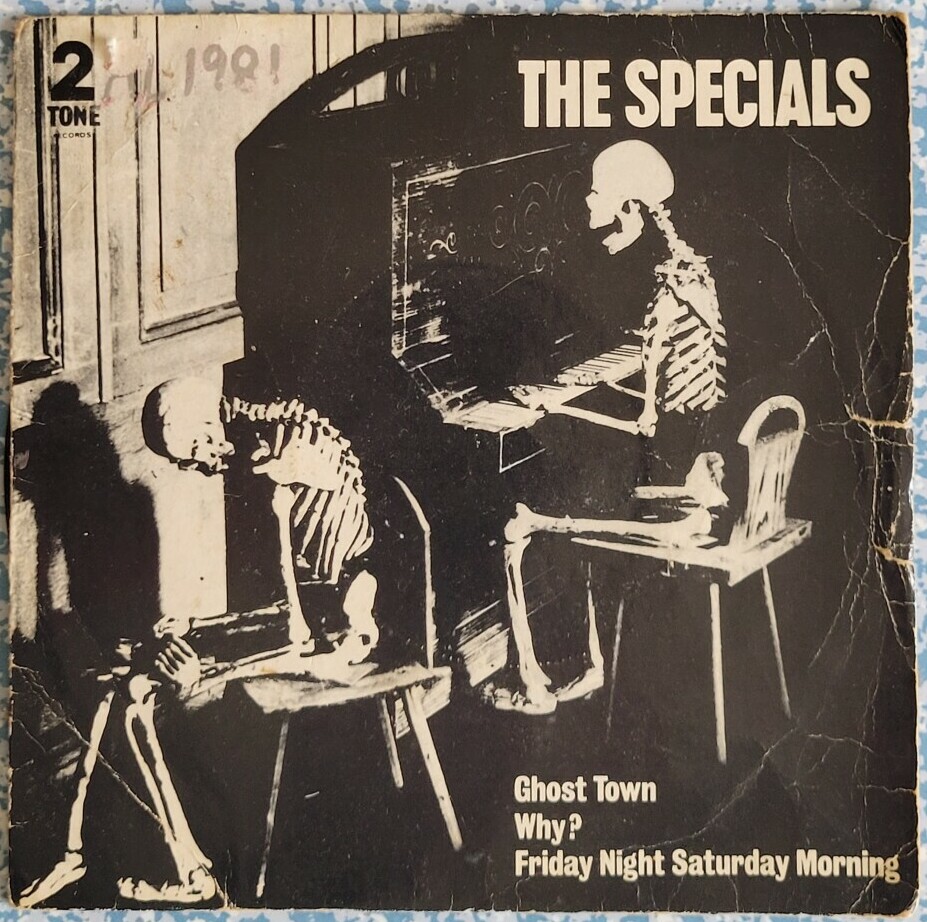
With its eerie, plodding beat and bleak lyrics, Ghost Town captured the mood of a society grappling with high unemployment and civil unrest. It’s a haunting reflection of societal disintegration, just as the country was swept up in royal wedding fever. The contrast couldn’t have been more stark.
As the nation was bedecked in flags and fanfare, Ghost Town provided a grim commentary on the realities faced by many Britons. Its success proved that even amidst the glittering fairytale of the royal nuptials, there was a thirst for realism and raw truth in music.
The Specials tapped into the national consciousness by voicing the fears and frustrations of a generation. For many, Ghost Town was more than a song; it was a stark symbol of division. It highlighted the hypocrisy of the pomp and splendour of a fairytale wedding broadcast to millions, promising a united front and a hopeful future. Whilst for many, their lives were devoid of both joy and hope. And appropriately enough, the future King was not even in love with the woman he was marrying.
In addition to the Specials’ fusion of ska, punk, and reggae – distinctive, yet not entirely untypical of the early eighties, 1981 embraced a multitude of genres from punk to synth pop and all points in between. Consequently, the UK charts buzzed with variety.
In addition to the Specials, we had punk-infused pop anthems of Adam and The Ants. These too were some of the most iconic tunes that not only climbed to the top of the charts but also captured the ethos of an extraordinary moment in British history.
Adam Ant, born Stuart Leslie Goddard, had his finger firmly on the nation’s pulse. Each Adam and The Ants song was a thread in the vibrant tapestry of the period, reflecting the hopes, fears, and desires of a nation on the brink of a new era.
Anthems of Rebellion: Adam and The Ants’ Stand and Deliver
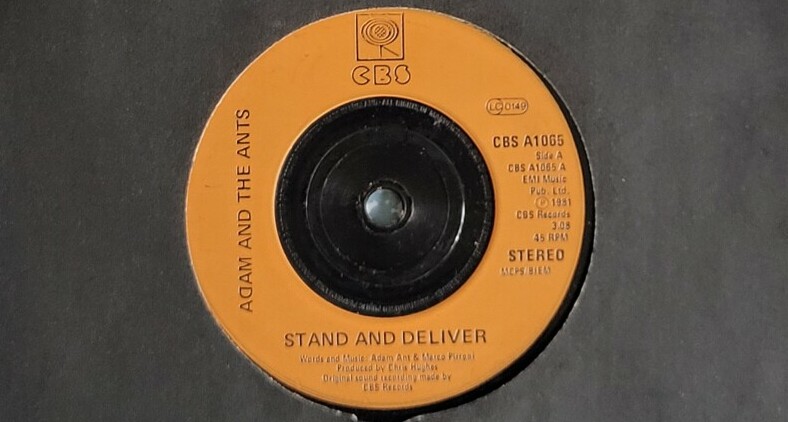
If there’s one track that captures the flamboyant spirit of rebellion in 1981, it’s Stand and Deliver by Adam and The Ants. This band, fronted by the enigmatic Adam Ant, was at the forefront of the New Romantic movement, which brought a splash of colour and theatricality to the UK’s music scene.
Stand and Deliver fairly exploded onto the music scene. Released in May 1981 it became the group’s first ever number one in the UK single chart when it arrived in the chart at the number one spot.
It became an instant anthem, courtesy of its infectious rhythm, driven by the band’s twin drummers Chris Hughes aka Merrick and Terry Lee Miall. Then, there are the defiant lyrics. Supposedly, they are aimed at Sex Pistols Svengali Malcolm McLaren, because of his skullduggery in the formation of his latest band Bow Wow Wow. They don’t half twist the knife.
Including phrases like, “the way you look you’ll qualify for next year’s old age pension,” and “so what’s the point of robbery when nothing is worth taking?” the lyrics have a particularly acidic tone.
The band’s performance art-style music videos further bolstered the song’s popularity, making a mark on MTV, which had launched that very year.
Musically, Stand and Deliver wielded a mix of punk rock’s raw energy and new wave’s synthesizer-driven melodies. The song’s success wasn’t just a triumph for the band; it reflected a growing appetite for genre-blending sounds that defied the status quo. Not to mention, Adam Ant’s iconic highwayman look inspired an entire generation of fans to don face paint and pirate garb.
In my opinion, the cultural significance of Stand and Deliver goes beyond its chart-topping achievement. It resonated with the youth of the day, who were searching for ways to express their individuality against a backdrop of economic uncertainty. The song’s rallying cry of self-assertion became a form of escape and empowerment for many during trying times.
Now, let’s march ahead to a completely different beat. Aussie band Men at Work introduced the world to a quirky and upbeat depiction of Australia with Down Under. Whilst both songs topped the UK charts, but the stories they told and the emotions they evoked were worlds apart.
Aussie Invasion and the Charm of Men at Work’s Down Under
Before 1981, Australia, known for its outback, wildlife, and the Sydney Opera House, had not made a great impact upon the UK singles charts – apart from The Seekers, the disgraced Rolf Harris, and Olivia Newton John.
This was to change in 1981 with Joe Dolce’s Musical Theatre with his Shaddap You Face (more of which later) and the rather slow burner that was Down Under by Men at Work. Although released in 1981, it took two years to reach the top of the UK singles chart.
It hit the top of the charts in several countries as it swept across the globe, beginning in Australia in December 1981.
By the late 1980s Australian acts such as INXS, Kylie and Jason along with Natalie Imbruglia and Midnight Oil, had all been spotted in the upper reaches of the UK singles chart. Some were more frequent visitors than others.
But anyway, that’s enough of that. Let’s focus on Down Under. It was certainly a catchy tune –downright infectious in fact. Its delightful flute riff and memorable chorus, it seemed to evoke the spirit of the land down under. These points, together with its longevity around the world, transformed the song into an unofficial anthem of Australia.
Down Under‘s Aussie slang and references won over listeners despite, or even because of, their strangeness to audiences the world over. It genuinely struck a chord.
Slang terms are thrown in aplenty, like “fried-out Kombi” – an over-heated Volkswagen van or “head full of zombie” – from zombie grass, a very strong batch of marijuana and my favourite, “where beer does flow and men chunder” – chunder, to vomit. I’m guessing a much-loved Aussie pass-time, presumably because they can’t take their ale! Or something.
The musical aspects of the track, partly McIntyre’s flute riff* and partly Colin Hay’s distinct voice, saw that Down Under brought a sense of joy and adventure that was hard to resist. The track not only reigned in the UK but also conquered global charts, establishing Men at Work as international stars.
When released the song and its video became a massive hit for the nascent MTV. The song tells the story of an Australian man travelling the globe, interacting with people wanting to find out about his homeland.
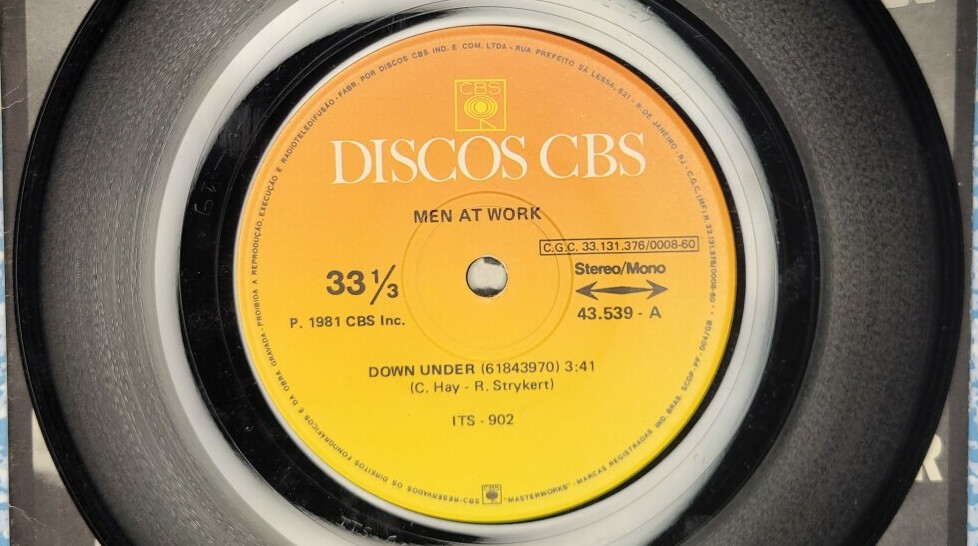
As I was only eleven at the time of its release I didn’t buy it then, instead, I waited for eight years or so until I was at university and bought it from a seller of second-hand records in the Student Union. Mine is the Brazilian print of the single, released on CBS Records. Although on 7″ it’s actually played at 33 ⅓ rpm. Now there’s a thing.
Men At Work In Hot Water
*In later years the track, in particular, the iconic flute riff, has been the subject of a copyright claim – the Kookaburra copyright lawsuit. Written in 1932, by a lady called Marion Sinclair, Kookaburra was a children’s classic in Australia.
It was so much of a classic that nobody noticed the similarities between the two songs until 2008 when it was first suggested on the Australian TV show Spicks and Specks that part of Kookaburra had been plagiarised.
Sinclair died in 1988 and the rights to Kookaburra were deemed to have been transferred to publisher Larrikin Music on 21 March 1990. She had not made the connection in her lifetime, and Larrakin hadn’t spotted the link either, but now suddenly, they wanted their share.
In the event, Larrakin won the court case. However, instead of 40, 50, or 60%, they were awarded 5% backdated to 2002. This was still a cool AUS$100,000 mind.
There’s a lot of opportunity in the nostalgia of hit songs. Down Under is frequently featured in films, commercials, and even sports events, proving that its popularity is more than just a memory; it’s a lasting tribute to the cultural bond between the UK and Australia.
Now, while Down Under gave us buoyant melodies and whimsical lyrics, the next section will pivot to a grudge match of sorts in the UK charts. We’ll look at an unexpected chart duel between Joe Dolce’s novelty ditty Shaddap You Face and the synth-driven sophistication of Ultravox’s Vienna.
The Unlikely Duel Between Joe Dolce’s Shaddap You Face vs. Ultravox’s Vienna
Now, let’s talk about one of the most unexpected chart battles of 1981. Who would have imagined that an Italian-American-Australian’s novelty song would go head-to-head with a British synth-pop masterpiece for the top spot on the UK singles chart? Yet, that’s precisely what happened when Joe Dolce’s Shaddap You Face clashed with Ultravox’s Vienna.
Shaddap You Face, with its catchy, humorous lyrics and simple accordion melody, captured the UK’s imagination, climbing swiftly to number one. Joe Dolce’s cheeky tune was initially written to celebrate his Italian heritage with a light-hearted, comedic touch.
Surprisingly, this novelty song found a widespread audience, staying at the summit for weeks, much to the chagrin of some music aficionados.
Meanwhile, Vienna by Ultravox offered a contrasting musical approach. It was a stylish, moody ballad paired with lavish production and an iconic music video. The song was praised by critics for its sophisticated sound and cinematic quality, heralding a new era in pop music that emphasized artistic visuals alongside musical innovation.
The rivalry became a hot topic in the industry, sparking debates about the nature of music success and what audiences truly wanted. A number one hit didn’t necessarily guarantee a lasting legacy, which brings us to the subject of influence over time.
Vienna might not have reached the top of the charts, but it has been recognized by many as a classic—the ultimate ‘song that got away.’
The cultural influence and public reception to both songs were as varied as their styles. Shaddap You Face was seen as a fun, albeit fleeting phenomenon. In contrast, Vienna has a timeless quality. It continues to be celebrated, frequently appearing in compilations and retrospective critiques of the era.
This rivalry succinctly encapsulates the eclectic nature of the music scene in 1981. It was a year where novelty could triumph over artistry on the charts, yet not necessarily in the annals of music history. This perfectly sets the stage to explore how 1981’s eclectic musical landscape has shaped the enduring appeal of these songs and their influence on trends that unfolded in the years to follow.
Any amount of analysis of the top of the UK singles chart at the time of the supposed duel shows that rather than Joe Dolce preventing Ultravox from reaching the coveted number-one position, it’s probably more accurate to point out that the real culprit was John Lennon’s posthumous hit Woman.

A glance at the top-selling singles for 1981 shows that Vienna outsold both Woman and Shaddap You Face in aggregate sales.
1981’s Musical Legacy and Beyond
Regarding the bestselling singles of 1981, the list of the top 50 has some tremendous tracks. Top of the list is the Christmas number one – Don’t You Want Me. The group responsible for this absolute icon of the period, The Human League, was a five-piece from Sheffield.
At the time, the group consisted of lyricist and singer Phil Oakey, singers Joanne Catherall and Susan Ann Sulley, plus musicians and songwriters Jo Callis and Philip Adrian Wright.
Don’t You Want Me, with its killer synth beat and irresistible hook, was a massive hit, spending a total of 5 weeks at number 1 in the UK singles chart. It sold an estimated 1.15 million copies, which was around a hundred thousand more than the second-best seller, Soft Cell’s cover of Gloria Jones’s Northern Soul classic Tainted Love.
Another iconic eighties track, Tainted Love reached number 1 in September and spent two weeks there. It spent a total of 7 weeks in the top ten.
Next up were two of Adam and The Ants’ offerings. We have already discussed Stand and Deliver which sold just shy of a million copies. Its successor, Prince Charming also got to number one and sold around three-quarters of a million copies. In total, the group had 4 of 1981’s top 50 sellers.
The fifth bestselling UK single of 1981, with approximately 740,000 copies, was This Ole House by Cardiff’s very own Shakin’ Stevens. It is hard to overestimate Shaky’s impact on the British pop scene. This Ole House was his first number of 1981, with Green Door being the second. Sandwiched between them was You Drive Me Crazy which made number 2 in the chart.
What I find most impressive about him is that he had done the hard yards, recording and gigging since the 1960s until his big break playing Elvis in his prime in the original West End Show Elvis!
Other notable tracks in the top 50 selling singles include Michael Jackson’s One Day In Your Life, Kim Wilde’s Kids In America, the Eurovision-winning Making Your Mind Up from Bucks Fizz, plus Roxy Music’s cover of John Lennon’s Jealous Guy.
Then there were a couple of songs you may not realise are quite as old as they are. Yes, Under Pressure by Queen and David Bowie, and Every Little Thing She Does Is Magic by The Police were also top sellers in 1981. As I write this, that’s only 43 years ago… Gulp!
OK then, there you go. A quick whizz through the hits of 1981. I’ve touched on the three singles from the year that I bought or, ahem, otherwise obtained.
Using the list of the top 50 selling singles to jog my memory, I’ve mentioned some of the other tracks that I loved. Of course, they may not be the ones that you remember. So, please, let me know what you remember – tell me in a comment.